Voting was supposed to be the beginning of the conversation.
For most of us, it's the end of one. Agora is the channel that should exist between citizens and the people who represent them, for the years voting alone can't reach.
The civic gap.
Between elections, something quiet happens: the citizen disappears, not by choice, but by design. We built infrastructure for voting. The years in between, we were left alone. The bills, the budgets, the votes that shape your street, your school, your future, with no reliable way to reach the people deciding them.
Call it the civic gap: the structural absence of any reliable channel between citizens and the people who represent them. It isn't a story about democracy in decline. It's a story about democracy that was never finished.
Roads existed before highways. Participation between elections is an unbuilt highway.
Why the channels we have don't work.
Citizens aren't apathetic. They use the channels they're offered - and the channels were built for something else. Here's what's available now, and why none of it was made for the years between elections.
Social media
Rewards outrage over signal. An official's post about a local bill drowns in national grievance from people who don't live in the district, or the country.
Email & contact forms
Most citizens who write never hear back; the ones who do receive a template. The volume is unprocessable, and nothing distinguishes a real story from a generic script.
Town halls
They work when they happen. Rarely, in one room, at one time, dominated by whoever is loudest and most available. A parent with two kids and a job has no realistic way to attend.
Polling
It works, technically. It's also expensive, slow, and reserved for officials with the budget. A representative voting next week can't afford a poll.
Voting was supposed to be the beginning of the conversation. For most of us, it's the end of one.
Three shifts make participation real.
The civic gap isn't a content problem. It's a structural one. Three shifts have to happen together — and Agora is built to make all three.
Volume is not voice. Twenty thousand identical emails crowd out two thousand specific stories. Structure the input, and the signal returns. An official should know what their district thinks — and what their district thinks they're missing.
Agora.
A platform where verified officials post the substance of their work — the bills they're voting on, the budgets they're proposing, the questions they want to put to their districts — and where citizens engage through structured participation, not broadcast comment.
B-2847 ◆ Housing Authority capital appropriation
I'm voting on $340M for capital repairs at our Housing Authority next Tuesday. The funding is real; the allocation is what I want to hear the district on. Before I cast, two questions —
Of these three priorities, which should the first $120M address?
- Boiler & heating systems61%
- Elevator replacement27%
- Building envelope & roofs12%
Local
Your council, your borough, your school board — the decisions closest to your street.
State
Legislators and statewide officials shaping the rules between city and country.
National
The bills and budgets debated in Congress, brought back to your district.
One loop, three movements.
The shape of the platform is intentionally small. The work is in keeping it that way — verified, anchored, and accountable to a constituency rather than an audience.
The official posts
A verified official puts the substance of their work on the page — a bill, a budget, a hearing, a question they want the district to weigh in on. No press release. No hot take. The actual line items.
The district engages
Constituents respond through structured channels — priorities, tradeoffs, specific stories tied to specific provisions. Verified addresses weight the signal. Volume doesn't drown out detail.
The signal returns
The official sees their district's actual position — broken out by question, by neighborhood, with the stories attached. They post what they took from it. The loop closes.
More than a contact form.
Agora isn't social media with politicians on it, a fancier inbox, or a polling firm. It's the infrastructure none of those were built to be.
Six rules kept.
The platform's value is in what it refuses to do as much as what it does. These are the rules we hold to even when other choices would be easier — or grow faster.
Structure beats volume.
Twenty thousand identical emails are not a signal. Structured questions, weighted by district, are. We design every interaction to produce something an official can act on.
Verified at both ends.
Officials are who they say they are. Constituents are who they say they are. Without that, this becomes social media with extra steps.
Bound to a constituency.
Every conversation is anchored to a real district. Outrage from elsewhere stays elsewhere. The platform is small on purpose.
Substance, not posture.
Officials post the work — bills, budgets, votes, hearings. Not opinions, not campaigning, not press. The substance is the conversation.
Acknowledgment is a feature.
Constituents who feel heard once stay engaged. We treat the response as a first-class part of the loop, not an afterthought.
Non-partisan by design.
Every elected official, every party, the same tools. The platform stays neutral; the work of representation never is.
A short reading list.
The ideas Agora is built on aren't ours alone. A few starting points — for friends in government, civic tech, and journalism trying to think about the years between elections.
A first glimpse of what we're building.
There is now a working alpha, open to anyone in the United States. You can follow the people who represent you and respond to what they actually do. Your representatives in Congress are there wherever you live; state and city government is deepest in New York, where we started.
An early alpha. Unfinished in places, and changing most weeks.
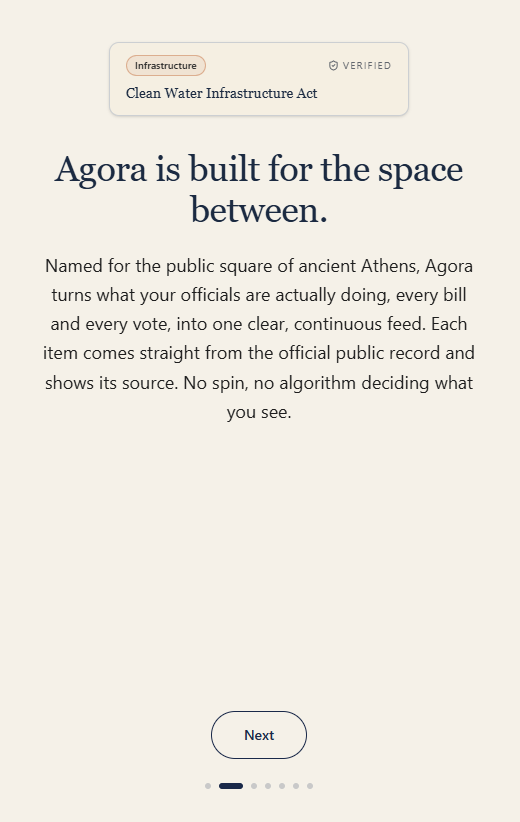
We need the right attention — not all of it.
There is no marketing campaign for civic infrastructure. There is only the slow accumulation of the right people who recognize what's missing. If this named something you've been thinking about, send it to someone who'd recognize it too — a friend in government, a colleague in civic tech, a journalist who covers democracy as something other than a horse race.
Or just leave your email, and we'll reach out when there's something to see.
Frequently asked.
Short answers to the questions we get most often. If yours isn't here, the waitlist form is the fastest way to ask.